The front seat of my Ford Fiesta while cruising vineyards in France

Wednesday, March 23, 2011

Polaner Selections at Gotham Hall

I'm right back in New York, this time for Polaner Selections grand tasting event for the trade at the cavernous Gotham Hall. Like Bowler the day before, this is a portfolio that offers an ample selection for savvy retailers and restaurants. There is too many wines to taste so this requires a brief study of what to look at.
Inside of Gotham Hall. A former bank building.

Polaner has developed a fine selection of Champagnes like Pierre Moncuit, Agrapart & Fils and Gatinois. Of particular interest was a rarely seen dry red wine from Gatinois. Similar to the better known Bouzy rouge, they offer an Ay rouge. This is an elegant, non-sparkling red made from Champagne's red grape, pinot noir harvested in their home village of Ay. It is a style similar to fine Burgundy. I last has this type of wine while dining at a restaurant in Reims, the center of the Champagne trade, a few years ago. 
Louis Cheval-Gatinois and wife of Champagne Gatinois. Louis is holding his bottle of Ay Rouge.

A new item and a stunning value was the Domaine de Pajot Cotes de Gascogne. A delicious, crisp white wine that would sell in most wine shops for $8 to $9. Another new label of interest was from Zuazo Gaston a producer from Rioja Alavesa. Alavesa are actually located outside of the Region of Rioja, just across some hills in Basque country. They have a distinct underlying tang of mineral with the bright, cherry, red berry fruit of the tempranillo grape. At a likely price of $8 to $9, it is another exceptional value.

As pinot grigio has become so popular these days, most are truly forgettable. Not so with Polaner's Muri-Gries from the Alto Adige region of Italy. This has consistently been one of the finest. Their reds made from lagrein are also quite good. Lagrein offers deep red fruits with a backbone of mineral and a fresh finish.
Caterina and Giuseppe Mazzocolin of Fattoria di Felsina in Tuscany. A superior source of Chianti farmed organically and made traditionally.

One of the last items I tasted was also one of the more memorable. Young Julien Masquin was offering his first vintage since taking over his family's vineyard. He make a wonderful Cotes de Rhone and Chateauneuf du Pape in the southern Rhone valley. His style is a welcome shade of elegance from the often brooding wines of that region.
Julien Masquin of Domaine Julien Masquin. He seems to have the admiration of his mother after I complimented his wines.

Tuesday, March 22, 2011

David Bowler at the Altman Building

Always one to look forward to, importer/distributor David Bowler's portfolio has a lot to offer. At the top of the leader board are the wines from my favorite importer, Joe Dressner. Most of his producers are in attendance and this gives me a chance to become reaccquainted with some that I have met before in France. I wish I had some kind of command of French as many of hiss vignerons have limited English and I have many questions.

David Bowler with Arianna Occipinti from Sicilia.

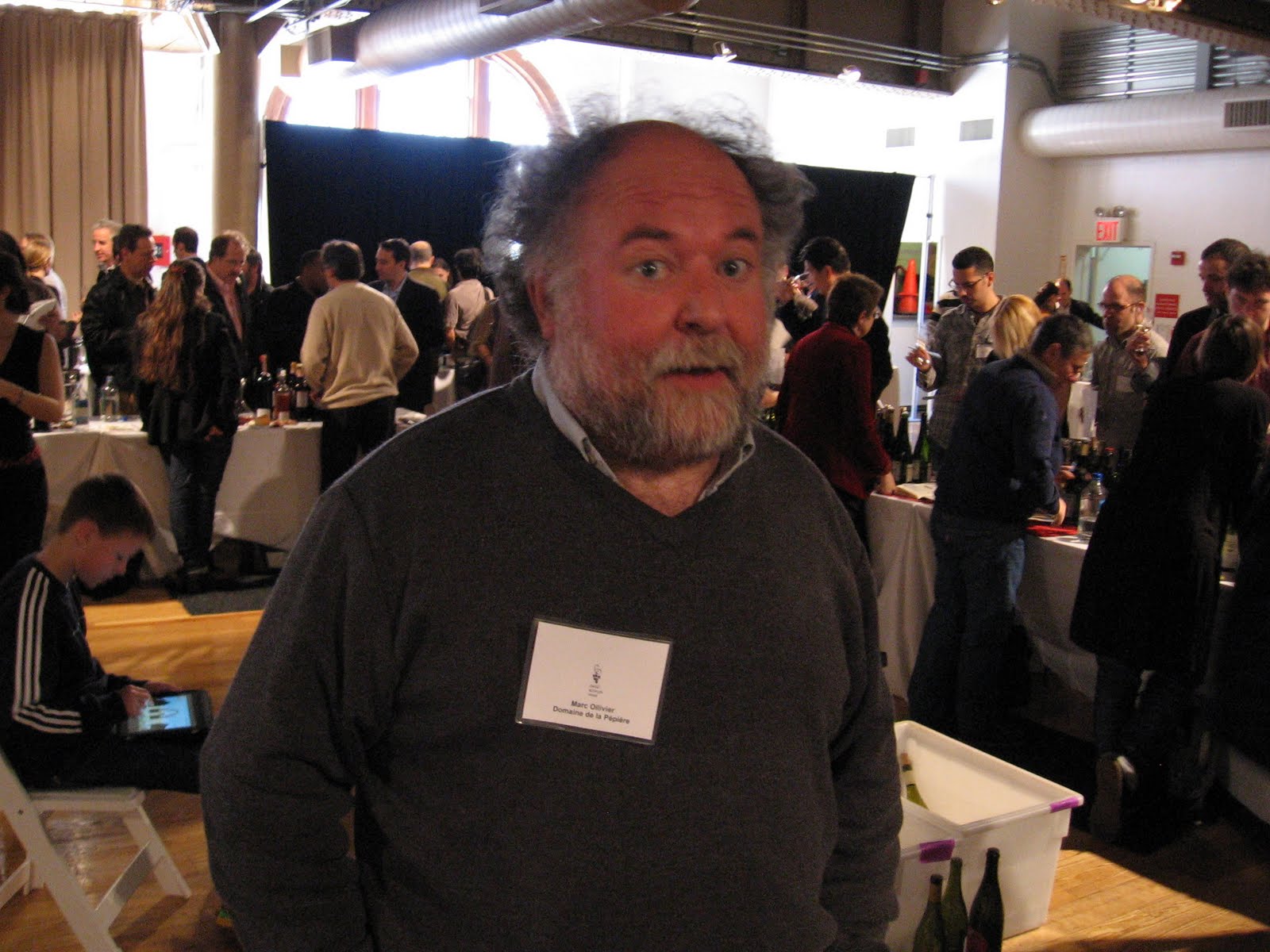
While tasting the wines of Marc Ollivier of Domaine de la Pepiere in the Nantes region of the Atlantic coast section of the Loire river, I told him that his Clos Briord Muscadet, a bright, tangy mineral/citrus driven white has been one of my personal favorites over the last few years. He liked that news. Marc also introduced a new sparkling wine made from the local grape, melon de bourgogne. It was just a bit sweet, the opposite of his bone dry Muscadet's, and should make a fine appertif.
Marc Ollivier of Domaine de la Pepiere. Making some of the tastiest everyday wines.

A newcomer to the portfolio was the young exuberance of Patrick Piuze of Chablis. Chablis is the oft misunderstood white wine region in the northernmost area of Burgundy, not the jug wine from California. Chablis makes lean, dry, unwooded wines from chardonnay. Every sip offers tangy lemon and nervy mineral flavors. Piuze's were exceptional, focused and well priced.
Jean-Paul Brun and his collection of exceptional cru Beaujolais.

Another nice addition were the wines from top importer Robert Kacher who has been bouncing around from various distributors. Let's hope he finds a home with Bowler. Karcher's wine are primarily from France and largely offer some spectacular values like Domaine Tariquet's perky Cotes de Gascogne, ugni blanc/colombard blend.

Damien Coquelet, the new face in Beaujolais
Coquelet's stylish label from the village of Chiroubles.

Herve Villemade is the type of classic, small family run winery in France worth a mention. Outside of some clever retailers and restaurants, his wines from the village of Cheverny in the Loire valley are virtually unknown. These are not collector wines, but are cherished for being so fitting for everyday life and the dinner table.

Herve Villemade
Villemade's Cheverny blanc label.


Monday, March 7, 2011

Jenny at The Smith - 2011

The Jenny & Francois Selections tasting, again held at the Manhattan restaurant The Smith, is the bi-annual event that I always look forward to. It is likely the most unique tasting event of the season. Not just because the portfolio is completely made up of natural winemaking techniques and organic vineyards, but the people attending this event are different than others.
The downstairs room at The Smith.
At  the tastings for premium distributors, there are the usual suspects of select liquor stores owners and Manhattan wine shops and restauranteurs. But somehow, many from those tastings are missing at Jenny's. It is a decidedly younger crowd that seem to be enamored with these natural wines like no other demographic. I have been attending the Jenny & Francois tastings since their beginning. I used to wear my usual wine tasting attire of casual dress shoes, jeans, dress shirt and sport coat. Not anymore. I am more casual here to fit in. I could likely be wearing a coonskin cap, snowshoes and have a husky under my arm and not even be noticed here.
Olivier Cousin of Cousin-Leduc. He makes a damn tasty Anjou cabernet franc. He also uses a horse to plow in the vineyards. Genius!
So why are the wine people at this tasting so different and younger. I'm not sure, but I believe that the largely Gen X/Y group are more open minded about wine and less attracted to the trophy wines. Sure enough, these wines are not easy to sell - unless you are truly enthused and dedicated. You can't just sit these out on the floor for sale. They really need to be explained before even sampled. To be hand sold. But these avant garde wine merchants and hip wine bars are really excited to offer something wholesome, unique and delicious. And I am completely with them or maybe they are completely with me.

Alain Rochard of Loup Blanc in Minervois.
The delicious Loup Blanc La Mere Grand (grandmother) Minervois aptly named for having come from old vines, mostly grenache.
Making natural wines isn't easy and the vigerons that Jenny and Francois find and represent are farmers with limited resources and land. Some wines are hit and miss, but most work and offer a fresh look on a new style of wine that is actually the old style of wine before a laboratory of additives and refinements became standard.
Domaine Sablonettes is always one of my favorites and this Le Bon Petit Diable cabernet franc is a new offering and another fav.

The problem with these winemakers is that their production is so small, I'm afraid there will not be enough to go around. Shhhh!     
Jenny on the right with Rita, the rep of the wines in NJ and PA.
C. Flemming Einfahrt, the world's foremost authority on accordion repair, dining at The Smith. How cool.

Friday, February 18, 2011

Casa Marcelo, Santiago de Compostella


During my last visit to Spain, I arraigned to spend a significant time in Galicia in the far northwest corner. It is a region that is just starting to become recognized for its fabulous wines made from obscure grapes like albariƱo, godello and mencia.

It was in this region that I had one of the most unusual meals of my life. While I often don't make reservations in advance, the restaurant Casa Marcelo was recognized as being a one star Michelin establishment and therefore "very good cuisine within its category". Casa Marcelo is situated within the world famous town of Santiago de Compostella an important destination among Christian pilgrims.

Casa Marcelo is a fairly inconspicuous restaurant on a small winding street. To get there we tried to convince a taxi driver to take us as we didn't know the layout of the city. Unfortunately he wouldn't take us. After awhile he finally made us understand that the restaurant was just a short walk away by drawing a simple map.

The thing is, I didn't know what made Casa Marcelo so unique until about five minutes after being seated. The dining room is fairly small without feeling cramped and lays adjacent to a spotlessly polished open kitchen. While we were the first seated for lunch, we soon noticed the absence of a wait staff. That's because there is none. There inst even a menu. That's because chef Marcelo Tejedor orchestrates the whole dining experience.

The menu is created daily based on market availability. After the chef recites the five course lunch he then assisted on wine selections. This is when he became his most animated. At first I didn't understand his point then he wrote down the object of his displeasure on his business card. Parker. He apparently didn't fancy wine critic Robert Parker's influence on wine. Join the club buddy.

Throughout lunch, Chef Marcelo delivered each course with a brief explanation in his native tongue. Each course was a delicate, focused and exquisite sampling of Galician cuisine that featured pristine seafood and creative platings. The combination of pleasant surroundings, outstanding food and an intimate experience with the chef made for one memorable time.

Tuesday, January 18, 2011

A Skurnik Tasting of Theise and DeGrazia

It has become custom for the importer/distributor, Michael Skurnik to start the season of tasting with samples of their prime importer partners, Terry Theise and Marc DeGrazia, which was held at Manhattan's City Winery.

Terry Theise has garnered a great deal of attention and praise for pioneering the import of small producer Champagne and has a stellar collection of German and Austrian wines. Italian importer Marc DeGrazia offers a stable of Italian thoroughbreds.

The Theise tastings are always on the top of my list as I has been an early advocate of his Champagnes, going back to my time working the retail floor in San Francisco in 1999, when I first became aware of these wines. For several years the Rene Geoffroy Champagne has been my personal favorite and is a classic example of the ten or so house Theise represents.

The Geoffroy family has been growing grapes in Champagne for several centuries, but this father and son team is part of a movement that is making their own wine instead of selling off their bulk wine to be part of a blend of a major house. Geoffroy, like others in the Theise portfolio farms from 14 hectares resulting in a tidy, handmade batch of 10,000 cases of distinctive juice from their village of Cummieres as opposed to the grande marquees that crank out 500,000 cases or more from multiple parcels.

That's the beauty of these small producers. They are so distinctive and of exceptional quality. It's a great start of the year.

Friday, December 31, 2010

In Chinon with Matthieu Baudry - August 2008

The third and final of my three visits to Loire vignerons would be at Domaine Bernard Baudry in Chinon. After leaving Olivier Lemasson, I toured parts of the Loire and arrived in Chinon in the early evening. After checking in to the two star Le Lion d’Or Hotel, I took a walk around the compact village scouting out a place to dine. After spending the last few days in tiny villages, Chinon (8,712 pop.) seems downright metropolitan.

Eventually, I chose Au Chapeau Rouge, a charming restaurant with an authentic Loire menu on a small, quiet square. I had the mid-range €38 menu Saveurs which started with medallions of jellied and smoked eel, a specialty of the region. The main course was a perfectly cooked fillet of bar (sea bass) over mixed steamed vegetables and potato with a delicate saffron sauce. The meal concluded with a selection of Loire goat cheeses and a dessert that featured different peach preparations. The wine was a Plouzeau Bonneliere Chinon, of course. Excellent dinner. Over the last two weeks I have been gorging myself on mostly German food, so it was nice to have an elegant meal. After a pleasant walk about town, I turn in.

The next morning, August 27, I wander out for a quick pain au chocolate and cafƩ before driving a couple miles to the Baudry home. The patriarch, Bernard is out of town so I am met by his hospitable son Matthieu who is also heavily involved in the winemaking.
The entrance to Domaine Baudry.
Domaine Baudry is in a walled and gated compound just outside the village. Early into our tasting we are joined by a couple visiting from Montreal, Quebec. This couple is very fortunate, as they will be sampling more than they expected.

The Loire Valley’s best known red wines are made from cabernet franc and Chinon is the most recognizable name. Baudry offers five bottlings of cabernet franc from a manageable 30 hectares (72 acres), 60% situated in the valley by the river and 40% on hillsides. There is the youthful Le Grange made from vineyards on the sandy valley soil. Their Le Domaine offers a more complex yet approachable blend of older valley vines with 30%-40% from the hillside vines.

Les Grezeaux comes from the oldest vines on gravel from the foothills between the sandy valley and clay-laden hillside. A more full-bodied and dense style that is tight when young, but ages well.

Le Clos Guillot comes from vines of ten to seventeen years old and are on the hillside which is clay over limestone. The wine is more concentrated, but with a bright, fresh, red fruit profile.

Here is an example of the Chinonais landscape from an adjacent property.
Here you have the lower valley floor vineyards on the bottom,
then the foothill bench, followed by the hillsides on top.

Finally, La Croix BoisĆ©e is their most serious wine for aging. Also from the clay over limestone hillside vineyards and from vines up to 40 years old. At about thirty days, the fermentation is around twice as long as the others and a bit longer in the barrel to tame the firm tannins. Like all of Baudry’s wines, the aging comes from used barrels to mellow the wine without imparting the taste of wood.

Back in the tasting room we taste through a 2005 Grezeaux, a 2006 La Croix BoisƩe, a 2007 Les Grange, a 2006 Le Domaine, and a 2006 Clos Guillot.

Next, Matthieu takes us to the tank room, situated in a modern climate controlled building. Instead of the usual stainless steel tanks, there is a row of about four or five newer wood fermentation vats opposing a uniform line up of sleek, sealed concrete tanks enrobed in crimson. They are empty right now, but will be in use within weeks for the upcoming harvest.

Seemingly out of place and sitting next to one of the concrete tanks is a single cylinder inox tank that is used to make their miniscule quantity of chenin blanc. I asked for a taste as I was not even aware they made any and it was delicious. Supple, smooth and a balanced essence of peach and apricot fruit with a hint of beeswax made in a style that offered just a trace of off-dry character. We also tasted a 2007 La Croix BoisƩe from the barrel awaiting to be bottled.

The entrance to the Baudry cave built into the hillside next to their compound.

The finale is a tour of the adjacent cave built into the limestone hillside. The cave is full of dusty unlabeled bottles. Matthieu grabs a couple bottles to open just outside on a barrel used as a table. First is a 2002 La Croix BoisĆ©e which showed subtle, fresh, floral scents dominating over a layer dried flowers with earthy red berry fruits and a remarkable, gentle texture. This was followed by a 1989 Les Grezeaux which showed a bricky color with a light rim in the glass. Dried flora and red fruits, hints of green bean aroma, but still ripe. Elegant acid – not flabby. Earthy mineral flavors over dried red fruit with a rich texture.

Stored bottles in the cave.

After a round or two of re-tasting and conversation with Matthieu and the Canadian couple, I part company to see one of the other neighboring cab franc villages, Bourgueil.

Matthieu Baudry pouring the '89 Les Grezeaux.

Monday, December 27, 2010

A Visit with Olivier Lemasson of Vins Contes - August 2008

 Vin Contes was the second of the three vignerons in the Loire that I had arranged to visit following a tour of Germany with importer Rudi Wiest in August 2008. Finding Vin Contes proved to be more difficult than expected. Not so much the town of Chitenay itself, which you could drive through in less than seven seconds and which is tucked into the countryside in the Touraine region of the Loire valley, but the route de Seur, the street where proprietor Olivier Lemasson’s facilities are situated. I drove through the town about four times before finally finding route de Seur.

Now comes the puzzle of trying to find the actual address. Again, I am reduced to driving back and forth on this small two lane road. I must have looked like a dog trying to find a lost tennis ball. Finally, I see the wooden nameplate next to a driveway, partially hidden by a shrub. The “Vin Contes” sign is about the size of a large, theater sized candy bar and well worn at that.

Now, like an intruder, I’m driving around the grounds, peeking around buildings, trying to figure out where he’s located.

Olivier Lemasson’s winery, Vin Contes, is nestled in the rear of a shared structure in the back of a farmers property. There is various farm equipment scattered about, some belonging to the farmer, some belonging to Lemasson.


Olivier (at left) directing the cleaning of the equipment.
 As I approach, he is supervising two young men in the cleaning of some equipment. Looks like pressing gear and associated items in preparation of the upcoming harvest. After providing the men some instruction, Olivier takes me into one of two modest rooms that make up his empire. The first is accessible via a large sliding garage door. This room contains a storage area for his equipment and a counter built against the wall with some stools, which is his office.

No receptionist, no sign-in at the offices of Vin Contes

Behind another door is a climate controlled room which holds a number of barrels and remaining boxed inventory. A rather unassuming amount as it doesn't take long to sell out. Aside from the air conditioning, this is very old school.
Olivier pulls out a few bottles to sample, including the "les Puits" sauvignon, "Algotest" aligote, "Les Rosiers" romorantin, "le Petit Rouquin" gamay and "Cheville de Fer" cot. I’m disappointed to learn the "Pinor de Soif" pinot noir is sold out and not available. Not even Lemasson has a spare bottle. I can’t say enough about Lemasson’s wines. They are natural, distinctive and just irresistibly delicious.


After the tasting he offers to take me to the vineyards. Approaching his car, it is the complete opposite of your Napa Valley Range Rover. It is a well worn Nissan coupe in oxidized black. The doors creak like an old man’s knees and when you close the door the rattle continues like a voodoo dance chant. It’s a great ride!

Following Olivier into the vineyard.

Lemasson, himself, is dressed for work. His soiled t-shirt and jeans give the appearance that he had just been wrestling an alligator in the dirt. Please, don't take this as a slight for this is a high compliment. It is nothing less than exhilarating to see the owner of a wine label actually getting into his work as opposed to one that enjoys the fruit of others labor, perhaps while covered with a cashmere sweater tied over their shoulders.

His modest five hectares of vineyards are about a mile away down the road. The impression I take in is how sparse the vineyards are. Sections instead of whole fields. A small island of vines in an ocean of sunflowers, wheat and fallow land. His vineyards more resemble a large home garden than the expansive fields of most commercial wineries. The soil on this day is dry and clumped, but during this 2008 season, there are signs of too much rain resulting in mildew damage. The soil is largely clay with some silex mixed in.

Back to his office, I basically hang out for awhile while enjoying some more of the Cheville de Fer on this sunny, comfortable Loire day. I’d rather be doing this than sitting by a hotel pool in a tourist destination any day.

T. Oliver Meek with Olivier Lemasson.

I’ll admit that there was a bit of shock at the modesty of his winery and of the man himself, but it represents everything I love about the Loire and this type of wine making. There is another level of comfort knowing Lemasson is in the good hands of the principled Louis/Dressner importer and an appreciative distributor like David Bowler and his staff.

As a parting gift, Olivier offers me a 1.5L bottle of his Cheville de Fer. This size is not sold by his U.S. importer and while it’s a load to carry around, it will be proudly served at Thanksgiving a year later.

Sunday, December 26, 2010

Clos Roche Blanche and Chateau Chenonceaux - August 2008

After finishing my ten day marathon tour of German wineries with importer Rudi Wiest and seven other peers in August of 2008, I set off on my own by auto from Frankfort to France. After a brief visit in Alsace and the Macon/Beaujolais regions of Burgundy, I advanced to my primary destinations in the Touraine region of the Loire Valley.

The first of my three visits to Loire vignerons would be at Clos Roche Blanche in the small village of Mareuil sur Cher and run by Catherine Roussel. The winery is named after the house built by her great-great grandfather in 1901. Wine making at Clos Roche Blanche was merely a pastime until Catherine’s father took over. Catherine now works with her partner, Didier Barrouillet, who handles the winemaking and vineyard affairs.

The day of my arrival in late August, 2008, was a sunny and mild summer day kissed with comforting breezes. The materials used to make their house gives you an indication of what lies beneath the clay and flint specked soil. It is an impressive structure of white limestone.

The one and only Clos Roche Blanche.

After greeting the host, Catherine introduces me to her border collie, Maggie and Maggie's offspring, Pif. As Catherine, Pif and myself begin the walk up the knob of a hill behind the house and to the vineyards we are joined by an uninvited kitten. She’s never seen the stray feline before, but the cat follows us around like a dog. I found out later that she named the cat Seccotine after a popular brand of glue.


Pif leading the way in the vineyard.

Roussel’s twelve hectare plot contains sauvignon, gamay, cab franc, cĆ“t (malbec) and small lots of cabernet sauvignon and pineau d’aunis. Clos Roche Blanche looks to grow organically and make wines with minimal intervention. These are some of my favorite wines on the market for being so pure and true to their varietal and terroir. These are the kinds of wine that rule with food and are a pleasure to drink on there own and I try my best to show these to customers.

The then un-named Seccotine trying to keep up in the vineyard.

Because I’m always looking to try new wines, I infrequently drink the same wine twice in a year. However, in 2009, their Cuvee Gamay had dinner me at least five times. Delicious red berry fruit with an irresistible mineral tang that you can’t put down.

Back in the vineyards, Catherine explains that while doing some vine maintenance, she’ll come across a sea creature fossil embedded in limestone debris. There are also wild mushrooms on occasion that she will bring home to the kitchen.

Maggie and Pif with Catherine at the entrance to the cave.

Above and behind the house is an access to the cave in the hillside where they will dump the harvested grapes to the presses and begin the winemaking process.

Inside the cave, with Pif and Seccotine still in tow, she shows me all the equipment and stored cases from past vintages. Here we take time to taste the sauvignon, cot, cabernet and pineau d’aunis with Didier, who is clearly taking a liking to the new cat.

Pif and Seccotine in the cave.

Le caveau.

Before I leave, Catherine presents me with a couple of limestone fossils imprinted with former sea life to take home and makes a phone call for a reservation for me at the terrific four star hotel and restaurant Auberge du Bon Laboureur in the enchanting village of Chenonceaux, a mere stroll to Chateau de Chenonceaux.
A view from the room. A section of the hotel
on the left and the village of Chenonceaux.

The hotel oozed old world charm and the restaurant offered an outstanding six course €85 Menu Gourmand dining experience that started in the gorgeous courtyard with a glass of sparkling Touraine served with an amuse bouche before being escorted and seated in the main dining room. The hotel’s fee at €125 was certainly more than the normal two star tourist hotel I would typically stay at, but was first class all the way and really, about the same price as a modest chain hotel in an average American city.

Chateau Chenonceax on the Cher river.
It was a luxurious night and offered needed rest before moving on to my next destination in Chitenay with Olivier Lemasson and his winery, Vin Contes.

Friday, December 24, 2010

A Xmas Eve Treat

While out shopping on Christmas eve I stopped at my closest Wegman's market which happens to be in Cherry Hill, NJ. and about 10 miles away from my Philadelphia home. Conversely, the closest Wegman's in my home state of Pennsylvania is in Malvern and 27 miles away. For the unfamiliar, Wegman's is an upstate New York based, family run supermarket that has transformed itself into a regional "lifestyle" shopping superstar. The stores are enormous, oddly yet seductively under-illuminated and hugely popular. They are the best regional supermarket in the country in my opinion.

Unfortunately for me, there are only opening new stores in large shopping arenas in wholly high-end demographics. There will be no Wegman's coming to my inner Center City neighborhood of high-rises soon. Not even to the wealthiest inner suburbs. Not enough room. I don't mind making the occasional trip over the Delaware River, but the four dollar, return-penalty bridge toll keeps the trips limited and carefully planned. Keeping mind that my idea of carefully planned is in the same method that a squirrel inventories its acorn burials.

It is during this holiday excursion, that I set off to bring home something interesting from Wegman's well stocked, clean and fresh seafood selections. In recent years, I have made seafood a focus of pre-holiday meals. Now I usually like to have Dungeness crab before New Years (more on that next week) and I have done lobster twice recently, so after a moment of thought and inspection, I decide to hand pick a dozen oysters from a iced bin set up next to the seafood case.

A half dozen Malpeques and six mysterious Glidden Points, as two of the markets seafood casemen gave separate hometowns. It was either from Nova Scotia or New Jersey? I suppose I could have gained a tie-breaker by asking a third party, but then what would have happened if I was given a third destination. I later found out at home the Glidden Points were from Maine.

After I finnished culinary school in San Francisco, I worked for a very helpful chef who had won contests for shucking oysters and I had opened some for service only a few times, so never became prolific. However, I'm not trying to open a sunken sea chest. It's just an oyster. I believe eve an otter can do with relative ease, though I've never seen an otter work in a raw bar.

As long as you have a good oyster knife and dish towel, it's not that complicated. I start by cleaning the oyster with a brush. This helps to clear away any grit and find the backend joint where you give a firm but controlled turn with the tip of the knife. Once cracked open, clean the knife on the towel and slide the knife across the inside of the top shell to cut the connecting adductor tendon then cut the bottom tendon. At the raw bar they would flip the flesh over to expose the cleaner side.

Here is Part A - the Malpeques with the La Pepiere Muscadet.

I paid special attention to opening them cleanly, not allowing shell bits to fall in the cupped side and to not spill the precious oyster "liqueur". These are the two keys to professional oyster service. As far as devouring them, I am purist in that I prefer just lemon wedges as a condiment, though will occasionally, at raw bars, use the vinegar, shallot and fresh crack black pepper based mignonette.

The night's special wine buddy was the pure shellfish classic pairing of Muscadet, the bright, crisp, lemony, minerally white wine from the Nantais region of the Loire Valley, adjacent to the Atlantic Ocean in France. Muscadet, aka, melon de Bourgogne, is the grape itself. Most mainstream Muscadet is generally a decent, dry white wine. That's why I made sure to take home one of the best on the market. Mark Olivier's Domaine de la Pepiere Muscadet from his Clos de Briord vineyard. The intense minerality of this particular wine is a stellar compliment to the briney, minerality of the two oysters.

Oysters are a healthy choice and raw bars are a fun dining option. Now with a little planning, they can be a new holiday tradition for you like I have made them for myself.

Wednesday, December 8, 2010

The Return of "Real" Lambrusco

Sometime around 2006, I bought a bottle of Italian wine with the type of topper that would indicate that it would contain some bubbles. A bulging head of the cork braced with a metal clasp. The label identified the bottle as Grasparossa di Castelvetro, which I was not familiar with and I assumed it would be a pleasant tipple like the lightly sweet and frizzante red Brachetto d'Acqui. So, with my mind wrapped around that thought, I was soured, literally and figuratively, by this dry, frothy, red wine with essence of wild fruits. It wasn't bad, just not what I was expecting. Actually, I didn't know what to think of it.

And there, was my first introduction with "real" lambrusco and like most consumers, I was faced with a lack of knowledge that grasparossa is the most common variety of the lambrusco grape, the unappreciated cousin to vitis vinifera, the noble wine grape. Forward a couple years later to 2008 while I was the wine director at a large South Jersey wine and spirits store. With that initial lambrusco experience and the curiosity to find it again, I went on a determined search for it. However, hunting for "real" lambrusco became more like trying to find a UFO with a raccoon tail attached to the antenna.

Then one day while browsing through a wine wholesalers product list, I found some. Since the importer, Frederick Wildman, is a quality supplier, I gave it a shot and bought a combination of all four available products from Cleto Chiarli to bring in the store and open for a public in-store tasting where I could evaluate them as well as gauge customer reaction. I was like a kid with a new toy and the customers were curiously delighted.

Tuesday, November 16, 2010

Market Time: London's Borough Market

I am absolutly an avid, perhaps rabid, food tourist. And one of my favorite places to visit are public markets, the caverous halls of food type. Among my favorites have been the St Lawrence Market in Toronto and the Mercat Boqueria in Barcelona. However, to date, the one I'd most like to return to is the Borough Market in London. The following is an exerpt from my travel journal of time spent in a planned layover in London before moving on to vineyards in France and Germany via the Eurostar a few years ago. The market won me over from the get-go with an bacon and egg sandwich.

The next morning, Saturday, I got up early and took the tube to London Bridge station on the south bank of the Thames to the Borough Market, London’s premier farmers market open on Friday and Saturday. London Bridge station is a tube and train stop with a great deal of activity. The market is across the street and looks like a large train shed, open to the elements except for a roof and some side sections.

The hypnotic smell of bacon drew me to a small stand for my first meal of the day. The stand featured a griddle with sizzling English style bacon, sausages and eggs. They offer a sandwich with either bacon or sausage with egg for £2.50. I opted for the bacon and egg with its deep golden yolk on the kind of soft, doughy roll that’s covered with white flour that covers your hand, but you don’t notice or care because the sandwich is so good. It was intoxicating with smell of bacon and the velvety texture of the egg all comfortably lying in the roll like a cat buried in a down comforter. I was really tempted to get another, but wanted to save my appetite for other culinary surprises.

The market has phenomenal small producer meats from England, Scotland and Wales, beautifully fresh seafood and gorgeous produce. There were also flowers, cheese, pastry and wine stalls. A fish stall had jellied eel which seemed popular and skate cheeks which looked enticing and made me wish I had an apartment kitchen in town so as to cook some of these items. A little down the street was a branch of Neal’s Yard Dairy, a well known source for top cheeses from Britain. Absolutely stellar.

Tuesday, October 19, 2010

Mary's Fish Camp

The lobster roll is a cherished New England delicacy and during some recent trips to New York, I had enjoyed a couple at Ed's Lobster Bar on the Lower East Side. While Ed's roll was good, I had no barometer of what's exceptional. After some internet research I found that New York Magazine had a useful write-up on lobster rolls. It seems Mary's Fish Camp, a small, well worn corner shop in the West Village offers a top rated roll.

Mary's menu is scripted on a large blackboard hung from the ceiling that along with some metal racks and tables separates the kitchen from the crescent shaped stainless steel counter and a smattering of tables. The menu descriptions and preparation are a simple and fresh. When I inquired about an appetizer of lobster knuckles, I was curious whether it was a proprietary name for a cleverly prepared lobster dish. No. It was steamed lobster knuckles.

The market price lobster roll ($30) came on a classic white diner plate. A heap of creamy mayo dressed lobster sprinkled with chives on the proper top-cut, butter toasted hot dog roll. This was outstanding. The lobster was cooked to perfection and the dressing was generous without being sloppy, keeping the the nuggets of meat together, the roll soaking up any excess without allowing any messy dribbles. The plate was garnished with a pile of unusual shoestring fries. Mandolin-cut like a flat noddle. They were decent, though a bit greasy. Though fries are the classic garnish, I'd rather see some green beans.

The lobster roll with glass of gruner veltliner.

Besides the roll, I was really impressed with the wine list. I'm a firm believer that small restaurants are better suited to having a tidy wine list that features quality/value over quantity. This makes even more sense when there is a severe lack of storage space. Mary's has about fourteen wines, mostly white of course and ones that make sense for a fish house. I had a pour of gruner veltliner from Setzer, a stellar producer from Austria, a varietal that I always felt was a good match with lobster.

I could have easily have picked the Corea godello, a frothy Xarmant Txakoli or sparkling Raventos Cava from Spain, Coleman pinot gris from Oregon or a delightful gamay rose from the Cote Roannaise in France. A juice glass substituted for a traditional wine glass. Though not a preferable vessel, I thought this was fitting for such a casual fish joint. Unfortunately, there were no taps for beer, but again, a well thought out selection of mostly craft brews.

While I arrived late in the lunch session when things were quiet, service was attentive and friendly. I now look forward to trying out Mary's other seafood dishes. Mary's is located at 246 W. 4th Street on the corner of Charles Street in New York's West Village. Go with the roll and rock with the wines.
http://www.marysfishcamp.com/2010/marys.html